
Reviewed · BAALBEK & ANJAR DAY TRIPS
Full-Day Private Trip to Jeita Grotto, Baalbek and Chateau Ksara
Baalbek is the star here: a vast Roman sanctuary with columns, courtyards, and stone blocks so large they still seem hard to explain. Pair it with the cool chambers of Jeita Grotto and a Lebanese wine tasting at Chateau Ksara, and you get a full day that moves from nature to ancient history to modern food and drink.
I like the private door-to-door transport, since Beirut to Baalbek is a long trip and you avoid the hassle of arranging several rides. I also like the mix of stops: Jeita is handled independently, while a local guide joins you at Baalbek. The main caution is time. Nine hours is a tight schedule, and entrance fees plus lunch are not included in the $69.45 price.
Key points to know before booking
- Baalbek takes the spotlight: The Temple of Jupiter and Temple of Bacchus are the day’s most powerful sights.
- Jeita has two cave levels: You see the upper cave on foot and reach the lower gallery by boat, when operating conditions allow.
- Chateau Ksara adds a Lebanese food-and-wine angle: The tasting is included, but the winery admission is not.
- Your group has the vehicle to itself: This makes it easier to keep the day moving and request practical adjustments.
- The day begins early: Pickup starts around 8:30 a.m. and the full outing lasts about nine hours.
- Entrance costs need planning: Jeita and the Baalbek complex are listed with admission fees excluded, so carry extra money beyond the tour price.
Three very different Lebanese sights in one day
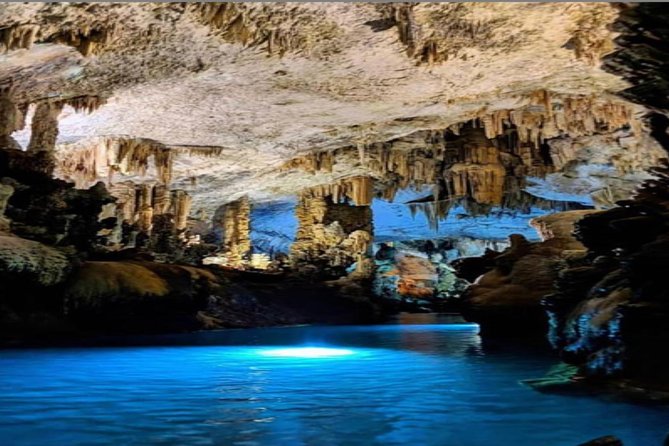
This private trip links three places that do not feel alike. Jeita Grotto is cool, dark, and shaped by water. Baalbek is open, sunlit, and built on a grand scale by ancient engineers. Chateau Ksara brings you back to the present with vineyards, cellars, and wine made in the Bekaa Valley.
That range gives the day its appeal. You are not spending nine hours looking at one kind of monument. At the same time, the schedule asks a lot of you. Jeita, Baalbek, and Ksara are spread across different parts of Lebanon, so a good portion of the day is spent in the vehicle.
The private format helps. You receive hotel pickup and drop-off in Beirut, travel in an air-conditioned vehicle, and have a tour leader with you. You also have a local guide at Baalbek, where a few clear explanations can make the broken stones and enormous courtyards much easier to understand.
More Jeita Grotto and Harissa runs:
- Guided Small-Group Tour to Jeita, Harissa, Byblos with Lunch
★ 5.0 · 361 reviews - Jeita Grotto,Harissa&Byblos Full-Day PRIVATE-CAR Trip from Beirut
★ 5.0 · 222 reviews - Jeita Grotto – Harissa – Byblos Trip
★ 5.0 · 169 reviews
Jeita Grotto: boats, limestone, and a cool start
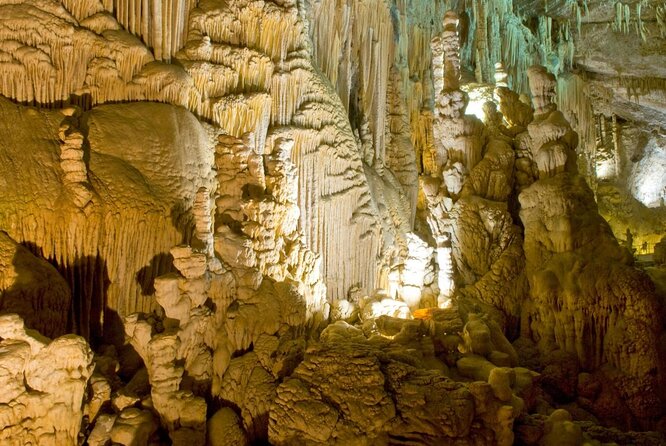
Jeita Grotto is the most unusual first stop. It is a two-level limestone cave system formed over millions of years, about 300 meters above sea level. The upper cave reaches roughly 2,130 meters, while the lower gallery extends for about 6,200 meters beneath it.
You explore the upper section on foot, where stalactites hang from the ceiling and stalagmites rise from the floor. Look for columns, curtains, draperies, pools, and mushroom-shaped formations. The appeal is not a single famous chamber. It is the steady change in shape and texture as you move through the rock.
The lower gallery is associated with an underground river and lake. A boat ride gives this part a different feel from the upper cave, with the water carrying you through the dark limestone passages. The tour description includes the boat and walking visit, but cave operations can depend on local conditions, so it is wise not to treat every feature as guaranteed on every date.
The stop lasts about 90 minutes. That is enough for a strong introduction, but not a slow, lingering cave visit. Wear comfortable shoes and bring a light layer if you dislike cool interiors. Admission is not included, an important detail when you compare the headline price with your actual spending.
Jeita works well at the start of the day because it is active without being strenuous. You are walking, boarding a boat, and looking closely at formations before the longer drive toward Baalbek. It also gives you an early change of pace from Beirut’s streets.
Baalbek: why the Roman ruins are worth the long drive
Baalbek is the reason to choose this outing over a simpler winery day. The site was known as Heliopolis during the Hellenistic and Roman periods, and its sanctuary honored a local version of a three-god cult: Jupiter, Venus, and Bacchus.
The setting matters. Baalbek lies in the Bekaa Valley near the Anti-Lebanon range, at an altitude of about 1,150 meters. The scale becomes clear as soon as you face the surviving masonry. This is not a small archaeological patch with a few columns. It is a broad complex of courts, platforms, temples, and huge carved blocks.
A local guide accompanies you here, which is useful because the site can otherwise feel like a collection of impressive fragments. The guide can connect the monuments to the Roman sanctuary, the older Phoenician religious tradition, and the long building program that took more than two centuries.
Plan on roughly 90 minutes for the main Baalbek visit, with additional time allocated to the individual monuments and nearby sights. The supplied schedule repeats several Baalbek entries, so the practical reading is that you receive an extended visit to the archaeological complex rather than several separate tours of the same place.
The entrance fee is not included. One itinerary line describes Baalbek admission as free, but the overall tour information clearly says entrance fees are excluded, and several Baalbek entries are marked the same way. I would budget for the site ticket rather than rely on the $69.45 price to cover it.
Temple of Jupiter and the art of going big
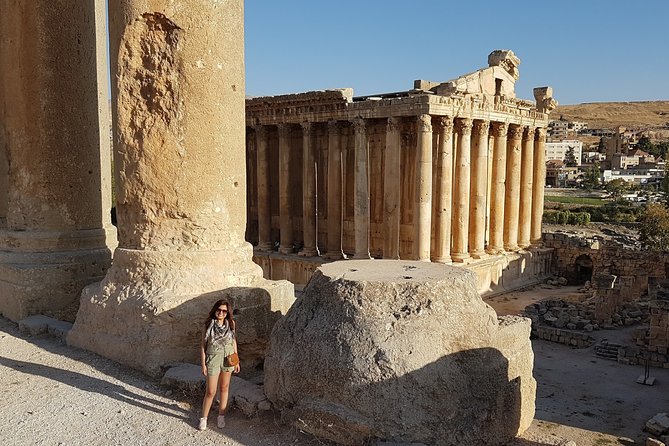
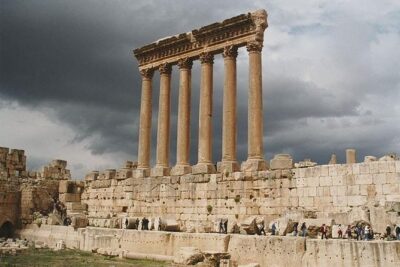
The Temple of Jupiter is the grandest part of the complex. Construction likely began around 16 BC and was nearly complete by about AD 60. The temple was dedicated to Jupiter Heliopolitanus and may have served as an oracle.
Only part of the temple survives, yet the remaining columns and foundation give you a strong sense of its former size. The building sits on a raised platform, with some of its foundation stones reaching extraordinary dimensions. Three blocks are counted among the heaviest ever used in construction.
This is where a guide adds real value. Without context, you may simply see tall columns and fallen stone. With an explanation of the platform, construction dates, and the temple’s religious role, the ruins become a lesson in Roman ambition and engineering.
Allow about 30 minutes for this section. The stop is short, but you will want time to look up at the columns and across the stone platform. The open site can be bright and exposed, so sun protection is sensible.
More Baalbek and Anjar circuits:
- Guided Small-Group Tour to Baalbek, Anjar and Ksara with Lunch
★ 5.0 · 511 reviews - Anjar, Baalbek & Ksara Day Trip – With Lunch (4G on Board)
★ 4.5 · 181 reviews - Baalbek – Anjar – Ksara Trip From Beirut
★ 4.5 · 80 reviews - Private Anjar and Baalbek Tour from Beirut with Departure Ticket
★ 5.0 · 79 reviews
Temple of Bacchus: the best-preserved showpiece
The Temple of Bacchus is smaller than the Temple of Jupiter, though smaller is a relative word at Baalbek. It is one of the finest-preserved Roman temple ruins in the complex, with detailed ornament and a powerful colonnade.
Its decoration is generally dated to the second century AD. The temple’s preservation lets you appreciate details that are easier to miss at Jupiter, including carved elements around the doorway and the repeated patterns in the stonework.
This is often the point where Baalbek feels less like a field of ruins and more like an intact architectural achievement. You can see how Roman builders used proportion, repetition, and ornament to create a sense of ceremony.
The scheduled visit is about 30 minutes, though the overall Baalbek stop gives you time to move between the temples. Entrance is not included, so keep your ticket budget in mind.
Venus, Sayyida Khawla, and the Stone of the Pregnant Woman
The Temple of Venus gives the complex a different shape. Built in the third century, it uses a horseshoe-shaped platform and a circular shrine with a square entrance. Niches decorated with dove and shell motifs helped identify the building with Venus.
It is a smaller monument, but that is part of its charm. After the giant platforms of Jupiter and Bacchus, the curved design feels more intimate and unusual. The scheduled time is about 30 minutes.
The nearby Mosque of Sayyida Khawla adds a living religious dimension to the Baalbek visit. It is believed to mark the burial place of Sayyida Khawla, the daughter of Imam al-Hussein. The site connects the ancient sanctuary to the religious life of modern Baalbek, rather than treating the city as a place frozen in Roman times.
The Stone of the Pregnant Woman is another brief stop, lasting about 15 minutes. This worked Roman monolith, along with another nearby block, is among the largest stones ever quarried. Its intended role was likely connected to the temple complex.
You do not need a long visit here. The point is to look at the sheer size of the stone and consider how ancient builders moved and positioned blocks of this scale. The stop is listed as free, but fees for the main monuments are separate.
Chateau Ksara: Lebanese wine after the ruins
Chateau Ksara was founded by Jesuit priests in 1857 and developed Lebanon’s first dry wine. The winery now produces about three million bottles each year and exports to more than 40 countries.
That background gives the final stop more substance than a simple tasting room visit. You are seeing one of Lebanon’s best-known wine producers in the Bekaa Valley, an area closely tied to the country’s wine industry.
The visit lasts about 45 minutes and includes a tour and tasting. This is enough time for an introduction to the winery and several wines, but not a slow afternoon of vineyard wandering. The tasting is included in the package, while the winery admission is not.
The timing also makes practical sense. After the early cave visit and the long Baalbek walk, Ksara gives you a seated, slower-paced finish. Lunch is not included, so ask your guide about the day’s meal plan before setting out. The schedule is full, and there may not be much spare time for a long restaurant stop.
Wine tasting and driving are a poor combination, so the private driver is one of the tour’s most useful features. You can sample the wines without needing to navigate the roads back to Beirut. Still, drink at your own pace, especially if you have a long return journey and several hours already behind you.
What the $69.45 price really buys you
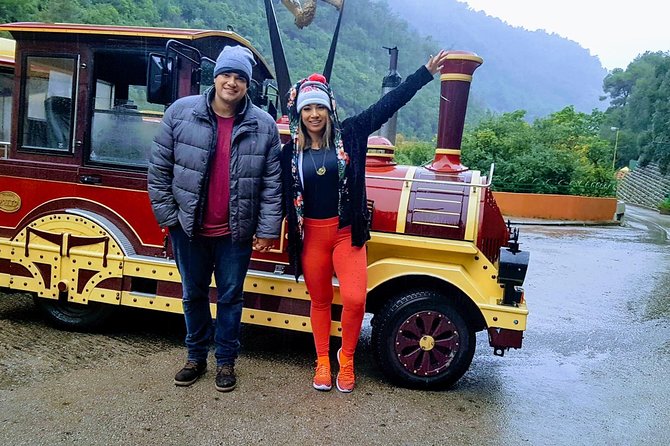
At $69.45 per person, the price is attractive for a private nine-hour outing with hotel pickup, drop-off, an air-conditioned vehicle, a tour leader, and a Baalbek guide. The private setup is especially valuable if you are traveling with family or friends, since the price may work better for a group than for one person traveling alone.
The price does not cover everything. You need to pay separately for entrance fees at Jeita, Baalbek, and Chateau Ksara, and lunch is also excluded. That means the final cost will be higher than the advertised amount.
I would compare this tour with the cost of arranging three separate visits and hiring transport for the Bekaa Valley. The distance and the number of stops make the private vehicle a strong part of the value. You are paying not just for admission, but for a full day of transport and coordination.
Group discounts are available, which may improve the deal for larger parties. Since this is a private activity, only your group takes part. That gives you more privacy than a standard coach tour and may make it easier to keep the day comfortable.
Timing, guides, and the private format
Pickup is scheduled for 8:30 a.m., and the complete experience lasts about nine hours. The order is Jeita Grotto, Baalbek, and Chateau Ksara, with the return to Beirut after the winery.
The exact pace matters. Baalbek alone can reward a slow visit, but this day also includes a cave and a winery. If you want long photo stops, an extended lunch, and detailed exploration at every monument, the schedule may feel compressed.
The operator has used guides and drivers including Hassan, Makram, Kaleeb, Ahmad, and Kimal. Their roles and availability can vary, but the service is designed around prompt pickup, practical communication, and an English-speaking tour structure where a local Baalbek guide explains the site.
The private vehicle also helps with changes. One account of the company’s service describes prompt arrangements for a last-minute booking, while another notes that the owner worked to correct a misunderstanding about a multi-day plan. I would still confirm your exact stops, meal arrangements, and entrance costs before departure.
Most people can take part, according to the supplied details. No special fitness level is stated, but you should expect walking at Jeita and Baalbek, uneven archaeological surfaces, and a long day in the vehicle.
Who should book this day trip?
I would choose this tour if you have limited time in Lebanon and want three major experiences without arranging transport yourself. It suits first-time visitors who want a broad introduction to nature, Roman archaeology, and Lebanese wine.
It also works well for private groups that value a flexible vehicle and direct hotel pickup. Families and friends can split the cost, use the group discount, and avoid being tied to strangers’ interests.
I would hesitate if your main goal is a relaxed winery day or a detailed archaeological study. The schedule covers a lot of ground, and Baalbek deserves more time than the timetable may allow. You should also be comfortable paying extra for admissions and lunch.
The cancellation terms are straightforward: cancel at least 24 hours before the start time for a full refund. Changes or cancellations within 24 hours are not accepted for a refund.
FAQ
What time does the tour start?
Pickup starts at 8:30 a.m. The experience lasts approximately nine hours.
Is hotel pickup and drop-off included?
Yes. Hotel pickup and drop-off in Beirut are included, along with private transportation in an air-conditioned vehicle.
Are entrance fees included in the price?
No. Entrance fees for Jeita Grotto, Baalbek, and Chateau Ksara are excluded. The Stone of the Pregnant Woman is listed as free.
Is lunch included?
No. Lunch is not included in the tour price.
Is the wine tasting included?
Yes. Wine tasting at Chateau Ksara is included, while winery admission is listed separately as not included.
Is this a shared group tour?
No. This is a private activity, so only your group participates. Group discounts are available.
Should you book it?
Book this trip if you want Baalbek’s monumental Roman ruins, a cave and boat visit at Jeita, and Lebanese wine in one efficiently arranged day. The private driver, hotel transfers, and local Baalbek guide make the $69.45 starting price appealing, especially for a small group.
Skip it if you prefer slow travel, a long lunch, or several hours focused only on ancient sites. For most visitors with one open day from Beirut, though, this is a strong way to reach Baalbek while adding two very different Lebanese experiences along the way.
More Full-Day in Beirut
- Jeita Grotto, Byblos and Harissa Full-Day Tour from Beirut
★ 5.0 · 23 reviews - Full-Day Private Tour to Jeita Grotto, Harissa and Byblos
★ 5.0 · 20 reviews - Beirut Full Day Walking Tour
★ 5.0 · 14 reviews - Guided Full-Day Private Trip to Cedars, Baalbek and Chateau Ksara
★ 5.0 · 10 reviews
More Bekaa Wine Afternoons
- Guided Private Full Day Tour to Baalbek, Anjar and Chateau Ksara
★ 5.0 · 60 reviews - Lebanon tour Baalbek ruins & Ksara w/pick-up, lunch,guide+entries
★ 5.0 · 35 reviews - Baalbek Temples & Ksara Caves w/pick-up,guide, entries+lunch
★ 4.9 · 34 reviews - Small Group Tours to Baalbek, Anjar & Chateau Ksara with lunch and Tickets
★ 5.0 · 29 reviews
Just added around Beirut
- Beirut to Sidon, Tyre and Maghdouché: Daily Tours with Lunch★ 5.0 · 3 reviews
- Exploring Beirut’s Past: A Private Guided Historical Tour★ 5.0 · 3 reviews
- Chouf Charm: Private Journey Through Lebanon’s Historic Heartland★ 4.5 · 3 reviews
- Hike Chouwen★ 5.0 · 3 reviews
- Private Trip to Beiteddine, Deir el Qamar & Maaser el Chouf Cedars★ 4.5 · 3 reviews
- Small-Group Tour with Lunch to Baalbek, Anjar and Ksara★ 5.0 · 3 reviews
- Lebanese wineries guided tour with tastings & lunch★ 4.9 · 3 reviews
- Baalbek, Anjar & Wine: A Journey Through Lebanon’s Heritage★ 5.0 · 3 reviews
Baalbek & Anjar Day Trips, compared.
Guided Small-Group Tour to Baalbek, Anjar and Ksara with Lunch
Read our review →
Anjar, Baalbek & Ksara Day Trip – With Lunch (4G on Board)
Read our review →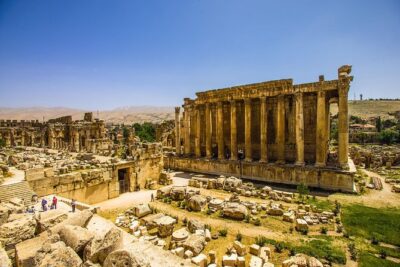
Private Anjar and Baalbek Tour from Beirut with Departure Ticket
Read our review →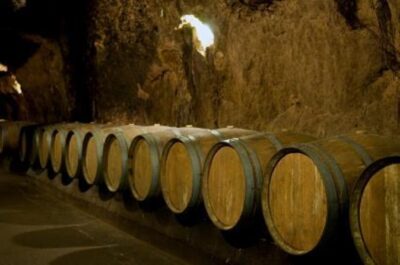
Guided Private Full Day Tour to Baalbek, Anjar and Chateau Ksara
Read our review →
Lebanon tour Baalbek ruins & Ksara w/pick-up, lunch,guide+entries
Read our review →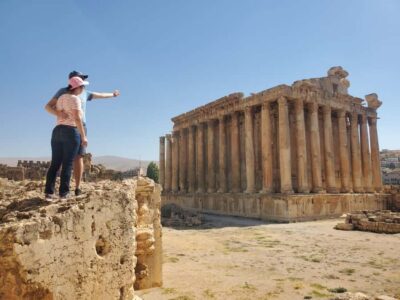
Baalbek Temples & Ksara Caves w/pick-up,guide, entries+lunch
Read our review →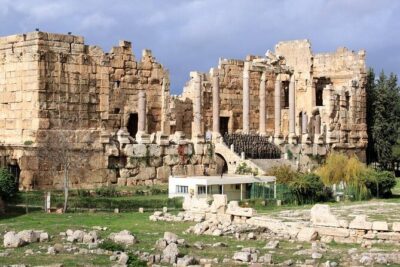
Small Group Tours to Baalbek, Anjar & Chateau Ksara with lunch and Tickets
Read our review →Browse the lists this tour appears in